
Special Collections
Spotlighting Keble’s Medieval Manuscripts
By Sophia Labys (Keble, 2025 MSc Digital Scholarship)
For one of Oxford’s younger colleges, Keble College has an impressive set of medieval manuscripts tucked away in its vaults. Of the Library’s Special Collections, totalling over 10,500 items, over 100 are medieval manuscripts. Many of these items were acquired by Victorian figures associated with the college. For example, Henry Parry Liddon bequeathed his personal acquisitions to the Keble Library upon his death in 1890, including 26 medieval manuscripts. Then in 1911, another significant donation was given, when the Canon Charles Edward Brooke (1847-1911) left the College over 300 manuscripts, incunabula, and early printed books that had been collected by his brother Sir Thomas Brooke (1830-1908).
While they vary considerably, many of the Keble manuscripts are united by their vivid detail and illustrations. The collection contains 33 books of hours, which were beautifully decorated personal prayer books used by laypeople. Other notable items in the Keble collection include the Regensburg Lectionary, a richly illustrated 13th century manuscript with over 600 pages. The Regensburg Lectionary was digitised in 2017, marking an important milestone for the Library.
As digital resources have become increasingly important for scholars across the world, many libraries have sought to keep up by digitising their materials. Digitisation has a variety of benefits: most significantly, it vastly expands access to rare or delicate material, allowing researchers to engage with it for much longer and with less restriction than in a library setting. It also frequently expands the audience that can look at these resources; since many digitised materials are open access, interested readers have far less barriers to seeing things they’re interested in. These digitised versions are also extremely high quality and allow for the digital preservation of fragile materials. The digitisation of the Regensburg Lectionary exemplifies these principles. Hosted at the Digital Bodleian, the manuscript is publicly available to any interested viewers, who are able to access all 600+ pages in high resolution.
As Keble has made strides towards digitising its collections, it’s a good time to look back at the scope of the Library’s collection, both digitised and undigitised. Keble’s medieval manuscripts are a particularly interesting site of study for their variety and beauty.
MS 63
One manuscript that has been recently digitised and made available for online users in Keble MS 63. This manuscript was produced around 1480 for Antonio Landriani (c.1440 – 1499), the treasurer of the Duke of Milan Lodovico il Moro. This book of hours is largely made up of text surrounded by detailed borders or populated by large decorative initials. Many of these borders include illustrations of saints and pictures of animals; this page, for example, shows the Virgin Mary and the infant Jesus accompanied by an illustration of rabbits.
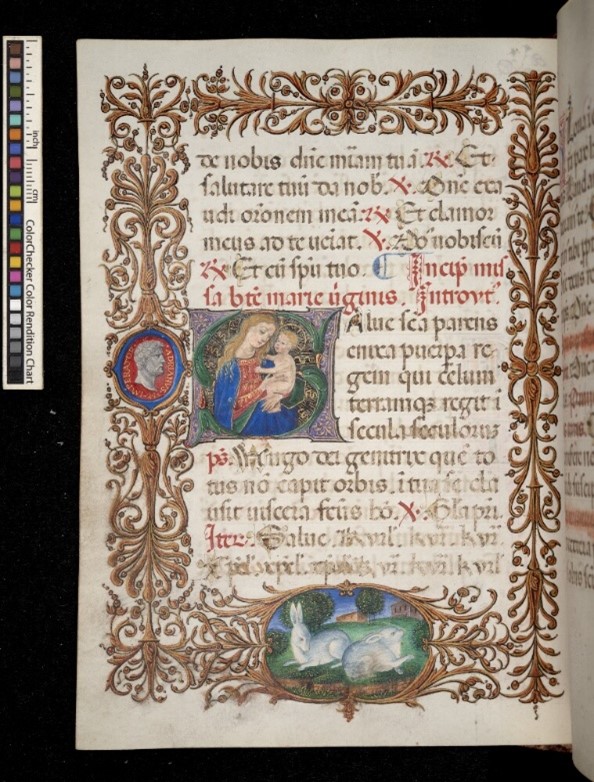
MS 63, fol. 64v
Other creatures featured in the book include a leopard, a deer, a partridge, and a monkey. While this text was a religious work, the visual aspect of the manuscript was key to its value, both to its patron and as a text.
In addition to being a highly visual text, this book was also quite personal. Books of hours were prayer books created for laypeople to use in their personal devotional practice. They were very expensive to commission and would have taken many hours to produce, and a piece like this would have carried profound value for its owner. This is further emphasized by a look at folio 22, which reveals someone we might not expect to see: Landriani himself!
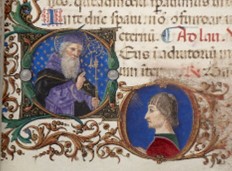
MS 63, fol. 22r
Landriani is shown being blessed by St. Antony, who was presumably his patron saint. This portrait isn’t the only glimpse of Landriani we see in the manuscript; his arms appear on folio 14 with the abbreviation “ANLA” and the name “Antonio” is also mentioned in prayers.
MS 18
Another manuscript for which we have a significant amount of background information is MS 18. MS 18 is one of the Medingen Manuscripts, the name given to a group of manuscripts produced in the Cistercian convent of Medingen in the late 15th century. Over fifty of these manuscripts survive today, and they represent the “highly developed devotional culture” of the convent between its internal reform in 1479 and the later Lutheran Reformation.
Many of the Medingen texts are individual prayer books written by nuns; while they share a similar liturgical structure, these manuscripts were written and adapted by individual women who engaged with their devotional culture on a personal level. Additionally, these manuscripts served to place their writers within a much older monastic tradition. While printed psalters were certainly available by the turn of the 16th century, the nuns chose to produce their own personal prayer books as “precious [objects]” that allowed them to exert influence and authorship over their devotional practices.
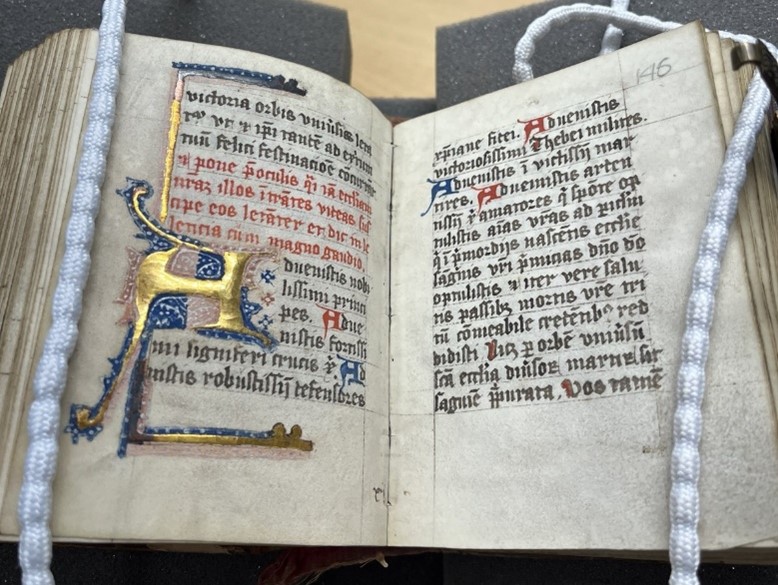
MS 18, fols 145v-146r (photo by Anaïs George)
Keble’s own Medingen manuscript, MS 18, was created around the year 1490 by the nun Mechthild Elebeke. Mechthild came from an influential family in the town of Lüneberg near Medingen, and she entered the convent with two of her sisters, Elisabeth and Tiburg. She received a great education and was proficient in Latin, music, and art. Mechthild wrote MS 18 as her personal prayer book, and she would have treasured it greatly; she also directly references herself in her prayers. The manuscript is dedicated to her patron apostle, Saint Thomas, as well as the convent’s patron saint, Saint Maurice. Interestingly, Mechthild’s sisters Elisabeth and Tiburg also wrote prayer books dedicated to their own patron saints, and with a healthy dose of luck all three of the sisters’ manuscripts survive today!
For more information on MS 18, see this excellent blog post by Anaïs George, which gives a great overview of MS 18 and gives particular detail on its illustrations and decorative intricacy. MS 18 is Keble Library’s next priority for digitisation.
MS 45
One of Keble’s most beautiful manuscripts is Keble’s MS 45, which has recently been digitised and is now available on the Digital Bodleian. This text was created in the late 15th century, likely in the Low Countries. Measuring only 116 x 76 millimetres, this pocket-sized manuscript fits an enormous amount of colour and detail into a small profile. The text and illustrated miniatures of this manuscript are surrounded by large borders filled with flowers, jewels, and insects. Snails, moths, and butterflies seem to move organically within the borders.
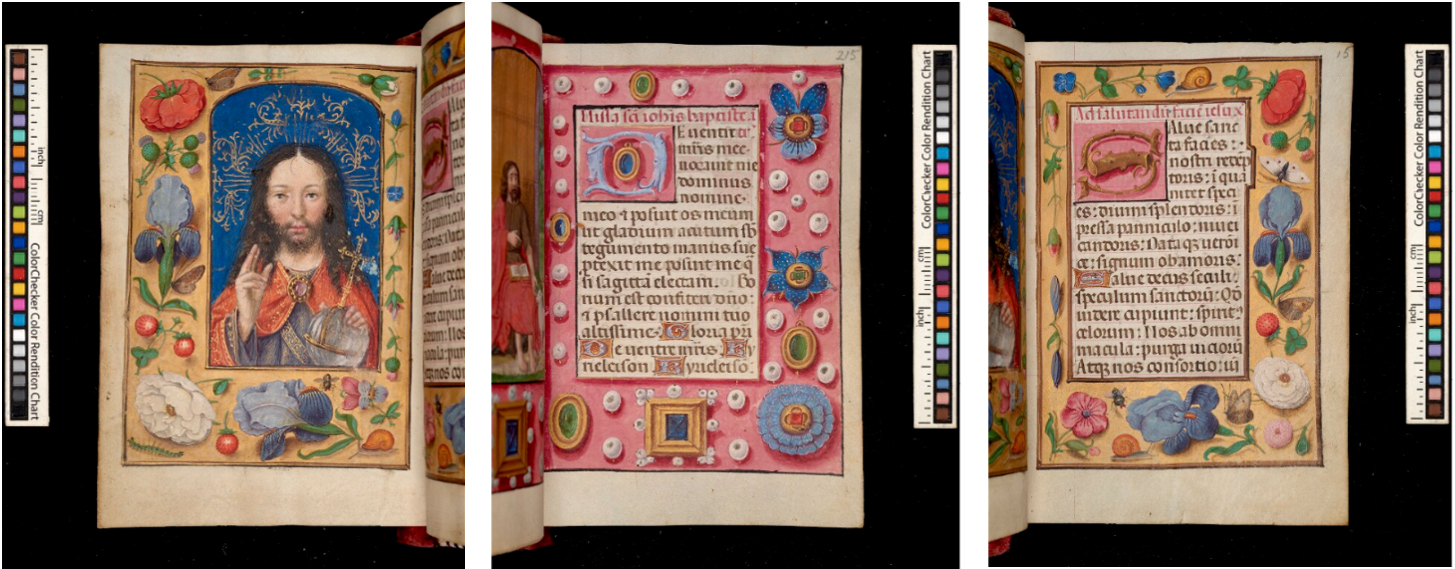
MS 45, fols. 14v, 215, 15
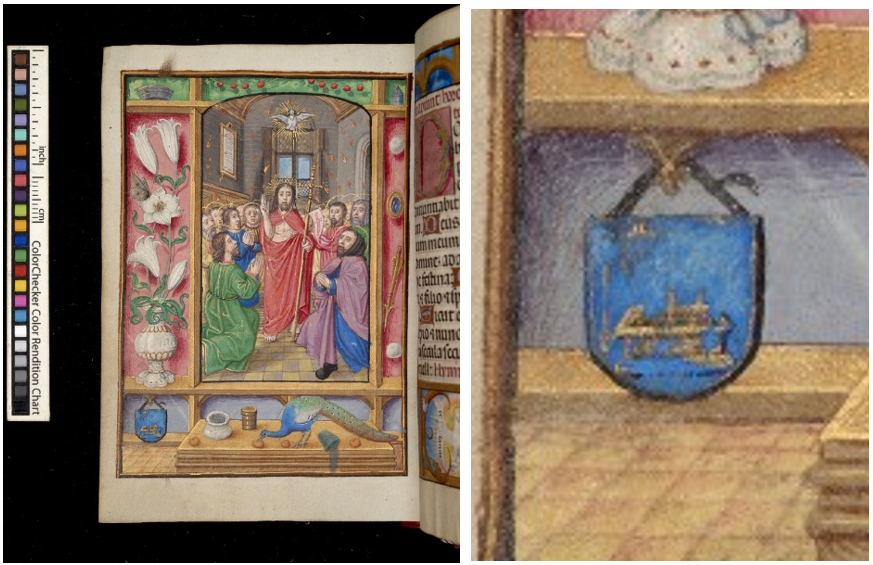
The book also contains an easy-to-miss detail: on the verso of folio 133, the lower left-hand corner reveals a coat of arms. At some point, this part of the manuscript was damaged, but it is unknown whether the removal of the arms was accidental or intentional.
MS 69
From the very small MS 45 we move to the very large MS 69. At 441 x 317 mm, this manuscript is large and heavy, exemplifying the variety of Keble’s collection even within its assortment of medieval texts. MS 69 is one book of a Bible in three volumes, produced around the early 14th century. It was likely produced in Liège in present-day Belgium, and it probably belonged to the house of the Teutonic Knights in Maastricht. MS 69 is the third volume of the set; while the first volume is not known to have survived, the second volume survives in leaves and cuttings held by the British Library and the Victoria & Albert Museum.
For more information on these other volumes, see the British Library Catalogue entry for Add MS 32058, fols 9-22. Additional information can be found at the V&A’s entry on the Teutonic Knights Bible, 9036E.
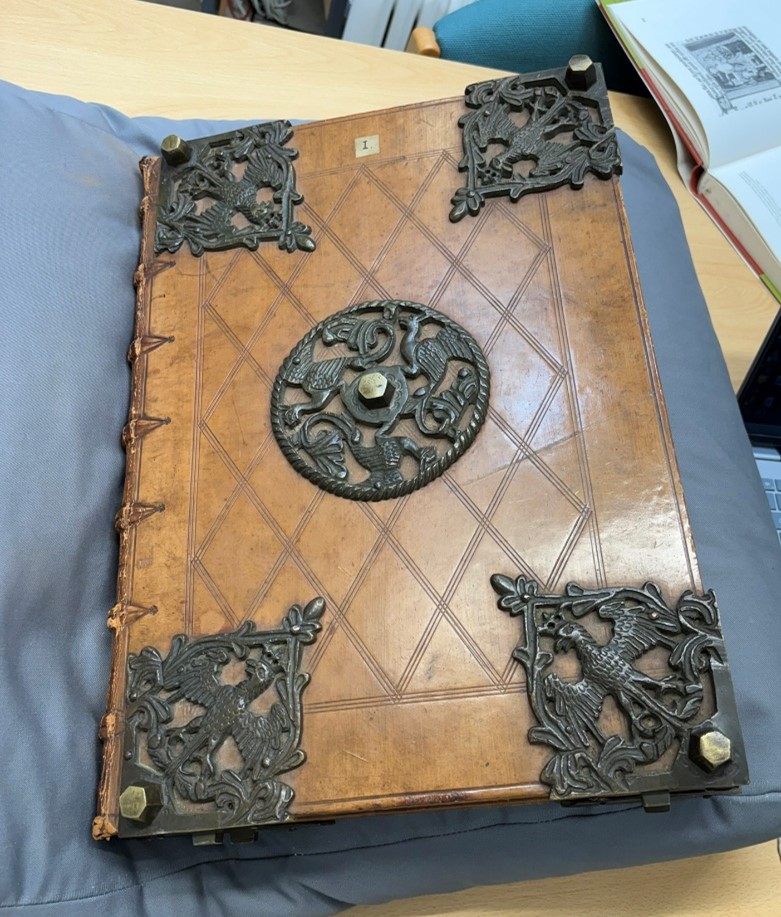
Keble manuscript’s binding is composed of heavy wooden boards covered by brown leather, with large brass bosses on the front and back. These brass adornments consist of a centrepiece and four cornerpieces, giving the manuscript a hefty profile.
MS 69, binding
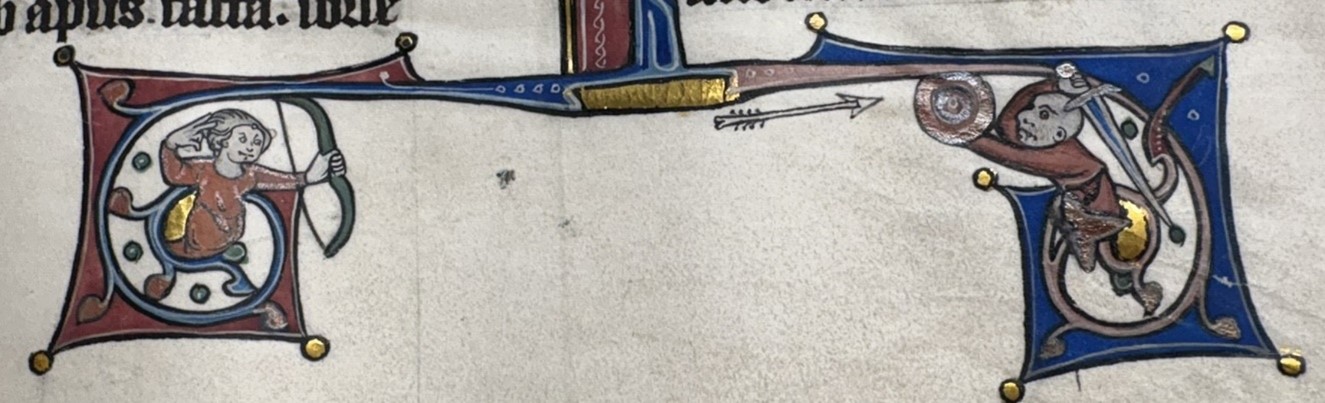
While MS 69 contains less visual detail than some of its compatriots, it is nevertheless a striking manuscript. Its text is accompanied by decorated initials, some inhabited by animals and figures. The detail inside the initials is beautiful: there are multiple illustrations of figures sitting at writing desks, perhaps echoing the scribe’s posture as they created this text. While the majority of the illustrations in this text are Biblical, there are also some more playful additions: this decoration on folio 32 displays a man shooting an arrow at a monkey, who defends himself with a sword and shield.
 MS 69, fol.32r
MS 35
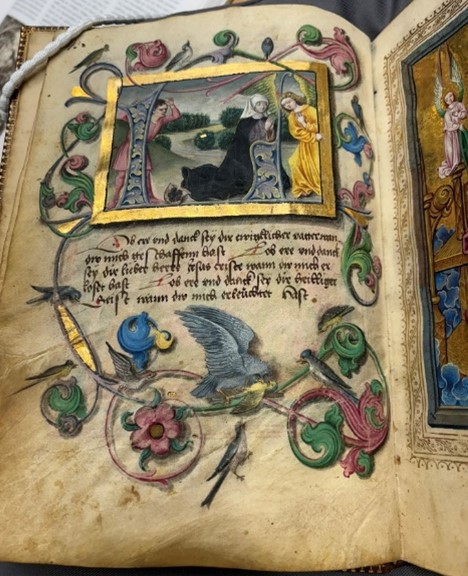
The final highlight of Keble’s collection explored here is MS 35, which stands out even among the Library’s impressive collection for its striking illustrations. Likely created in the late 15th or early 16th century, this manuscript is a prayer book in German with illustrations depicting the life of Christ. It was commissioned by an unknown patron and was likely created in Eastern Franconia. Like MS 63, this text contains an image of the book’s patron. The patron is a woman, and she is portrayed kneeling inside the initial L. She is also accompanied by an angel who points towards the facing page, which depicts the Holy Trinity. The prayer included on this page is directed towards the Trinity, displaying how the text of the manuscript links closely with the decoration to create a strong unified religious meaning for the person who used it.
MS 35, fol.2v
MS 35 is structured as a “series of private prayers or meditations based upon incidents in the life of Christ,” each of which faces a full-page illustrated miniature.” The space under each prayer is populated by floral and foliar decoration inhabited by a figure, who is often interacting with the facing page by pointing, averting their eyes, or holding items associated with the scene. Many of these figures can be identified as Biblical or traditional characters; for example, the below image depicts Veronica offering Christ her veil, a conventional detail in the Biblical story.
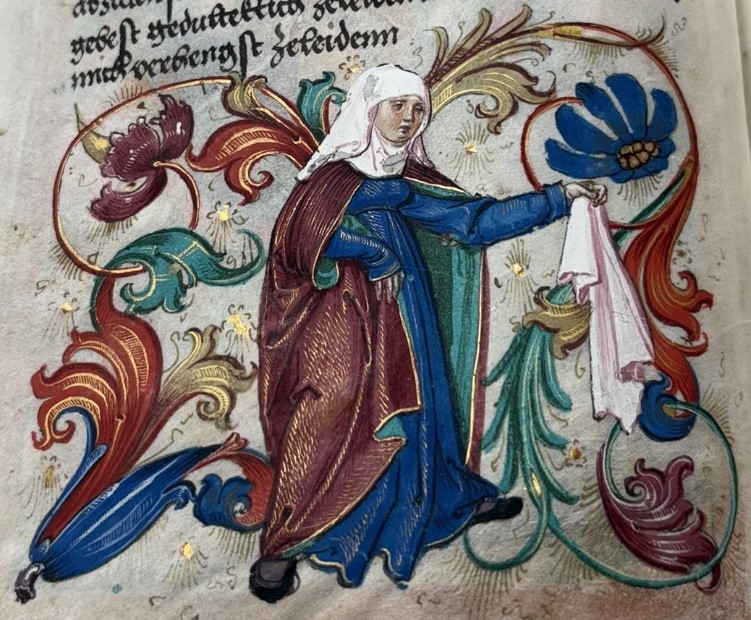
MS 35, fol.36v
These figures create a dynamic sense of movement throughout the manuscript. They not only link to the story of Christ, but they direct the reader and engage them in the emotive power of the devotional text. They also serve as pieces of art in their own right; every figure seems to bring its own personality.
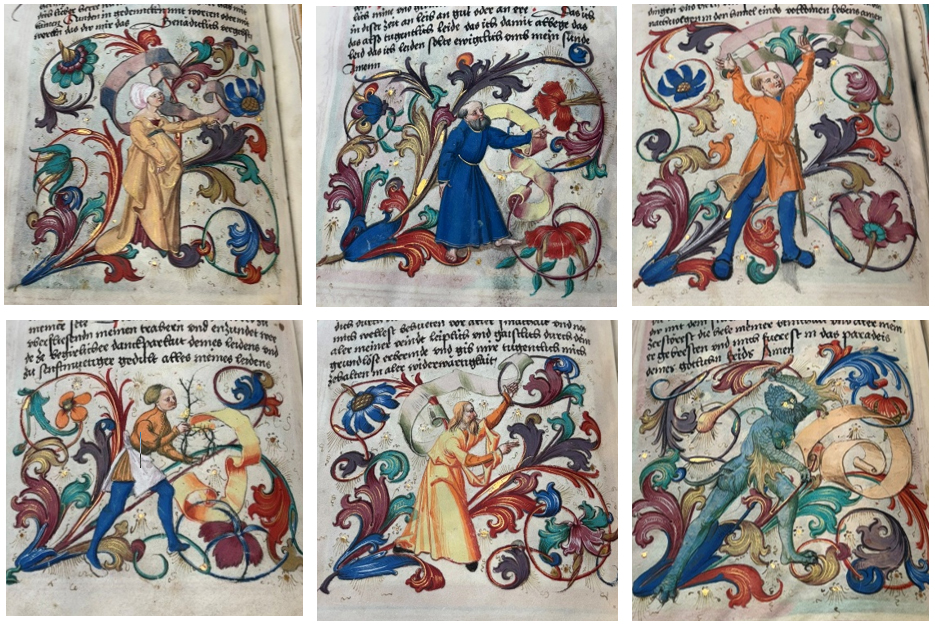 All images from MS 35. Starting with the top row, from left to right: fols. 60v, 52v, 90v, 66v, 65v, and 86v
While many of the illustrations in this text seem merely to accentuate the beauty of the manuscript, a closer look reveals the startlingly dark tone of some of the images, particularly as the text progresses. On the full-page depiction of Christ before Pilate, the figure on the facing page is not pointing or engaging with the image of Christ: instead, the decoration is inhabited by Judas, hanging from the gallows. MS 35 illustrates how the devotional intensity of these texts as religious sources could be echoed in the visual intensity of the manuscript itself.
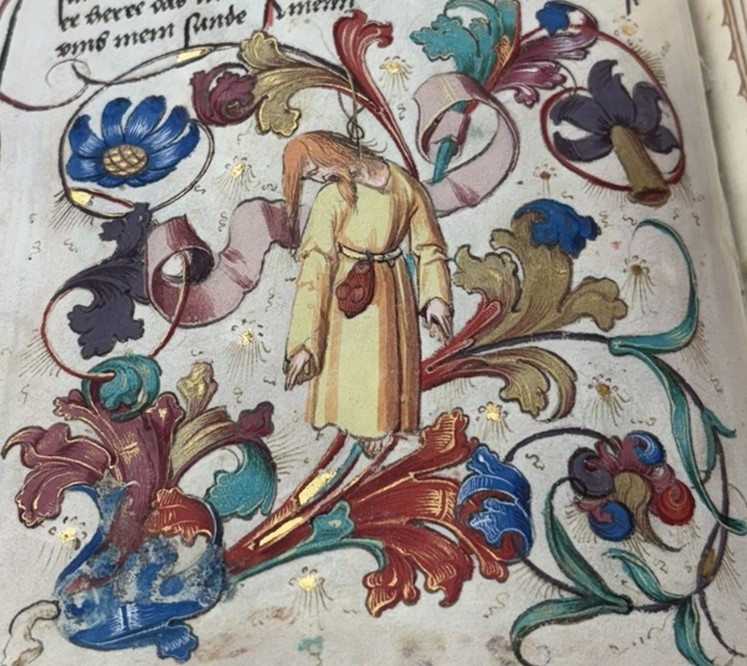
MS 35, fol. 58v
Conclusion
These manuscripts are only a small subsection of Keble’s Special Collections, but they display the depth of what it can offer. The shared visual and devotional complexity of these works is particularly relevant for understanding their place in the college’s Special Collections as a whole. The vast majority of Keble’s Special Collections were assembled in its first 45 years, and many of its early benefactors were sympathetic to, or even members of, the Oxford Movement. Members of the Movement were interested in “the traditional services that lay behind the Book of Common prayer itself,” sparking interest in ancient and medieval liturgy. However, Keble’s collection cannot be solely attributed to the theological ideas of the Oxford Movement. M. B. Parkes, the palaeographer who published a catalogue of Keble’s manuscripts in 1978, argues that as much influence can be attributed to a late Victorian interest in antiquarianism.
The study of the manuscripts that make up Keble’s collection, which M. B. Parkes calls “the most remarkable collection of illuminated manuscripts preserved in an Oxford college library,” provides valuable insight into both the medieval devotional world and how Victorian collectors curated this material based on their own interests, beliefs, and aesthetics.
The recent digitisation of MSS 45 and 63 rounds out the first ten digitised items in Keble College Library. While the digitisation of manuscripts like these is valuable for our understanding of Keble’s own context, putting these manuscripts online is even more significant for its expansion of access to a wider audience. As Keble Library works to secure funding for further digitisation of its manuscripts, it’s worth remembering the depth of knowledge made possible by the study of texts like these and how digitisation can open access to the world beyond the walls of the college.
Bibliography
Attar, Karen, ed. Directory of Rare Book and Special Collections in the UK and Republic of Ireland. Facet Press, 2016. https://doi.org/10.29085/9781783301485.
Dorgan, Gennifer, et. al. “The Medingen Manuscripts at Harvard: MS Lat 395 and MS Lat 440.” Harvard Library Bulletin 28, no. 2 (2017): 1-56. http://nrs.harvard.edu/urn-3:HUL.InstRepos:42660040.
Lähnemann, Henrike. “The Materiality of Medieval Manuscripts.” Lecture, St Edmund Hall, Oxford, 21 January 2016.
Parkes, M. B. The Medieval Manuscripts of Keble College, Oxford: A Descriptive Catalogue with Summary Descriptions of the Greek and Oriental Manuscripts. Scolar Press, 1979. https://hdl.handle.net/2027/mdp.39015002134081.
Lähnemann, Henrike. “From Devotional Aids to Antiquarian Objects: The Prayer Books of Medingen.” In Reading Books and Prints as Cultural Objects, edited by Evanghelia Stead. Palgrave Macmillan, 2018.